

If the lights at the end of a garden run look weaker than those near the power supply, voltage drop is one possible cause. It can also contribute to unreliable operation when a fitting receives less voltage than its specified input range.
Understanding voltage drop in lighting helps you choose cable and plan a layout before buying. It also explains why a larger-wattage transformer does not necessarily solve a dim-light problem.
What is voltage drop?
Cable and connections have electrical resistance. When current flows through them, some of the supply voltage is lost along the route. The light receives the voltage left after those losses.
The result depends on the fitting. Some lights may dim; others with regulated electronics may maintain their output until they reach an operating limit, then flicker or switch off. Brightness alone is therefore not a reliable measurement of cable losses.
This guide concerns the extra-low-voltage side of a lighting system. It is a planning explanation, not a specification for mains wiring or a substitute for the equipment manufacturer’s installation requirements.
The four things that matter most
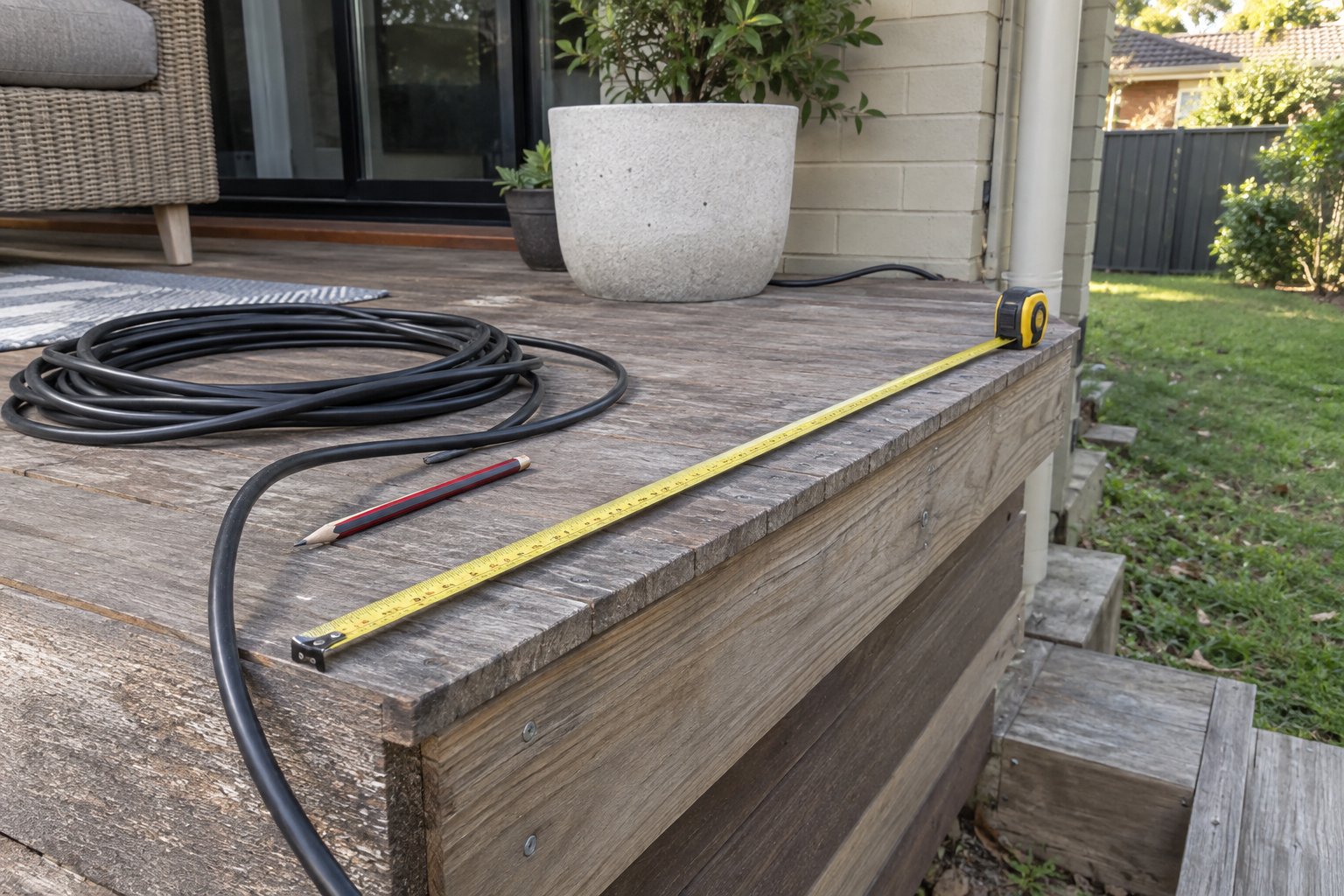
Cable length: a longer route generally adds resistance. Include the distance from the supply to the first light, not just the spacing between fittings.
Conductor size: a larger copper cross-sectional area generally reduces resistance. Check the actual conductor area in mm². An outside cable diameter or an ambiguous automotive size description is not the same measurement.
Current: greater current causes a larger voltage drop through the same resistance. Add up the loads that each section of cable supplies.
Connections: poor, corroded or unsuitable joints can add resistance. Buying heavier cable will not compensate for an unreliable connection.
Why the return path counts
In a typical two-wire DC circuit, current travels out to the load and back to the supply. Both conductors contribute resistance. A light 10 metres from the supply has approximately 20 metres of conductor in that complete circuit.
Some calculators ask for the one-way distance and automatically include the return. Others ask for total circuit length. Read the input instructions carefully; doubling the distance twice gives the wrong result.
Real garden runs often contain several lights at different positions. The first section carries the combined downstream load. Later sections carry less current as loads branch off. A calculation that treats every light as being at the far end is a simplified estimate, not an exact model of that layout.
A simple 12V example
Assume a nominal 24W DC load is located at the end of a 10-metre one-way copper cable run. At 12V, nominal current is 24 ÷ 12 = 2A. For an illustrative 1.5mm² conductor, using copper resistivity of approximately 0.0175 Ω·mm²/m at 20°C, the loop resistance is 0.0175 × 20 ÷ 1.5 = 0.233Ω.
The estimated drop is 2 × 0.233 = 0.47V, or about 3.9% of 12V. The estimated voltage at the load is about 11.53V.
This is a teaching example, not a cable recommendation. It ignores connection losses and temperature effects and holds current at the nominal value. Actual LED electronics can change current as voltage changes. Check the fitting’s permitted input range and the manufacturer’s design limits.
What changes at 24V?
For the same nominal 24W load at 24V, current is approximately 1A. Using the same illustrative cable resistance, the drop becomes about 0.23V, or roughly 1% of the starting voltage.
That is the practical attraction of 24V for some longer runs. It does not mean you can convert an existing installation by changing only the supply. Every light and controller must be compatible, and the cable and protection still need to be correctly selected.
How to reduce voltage drop
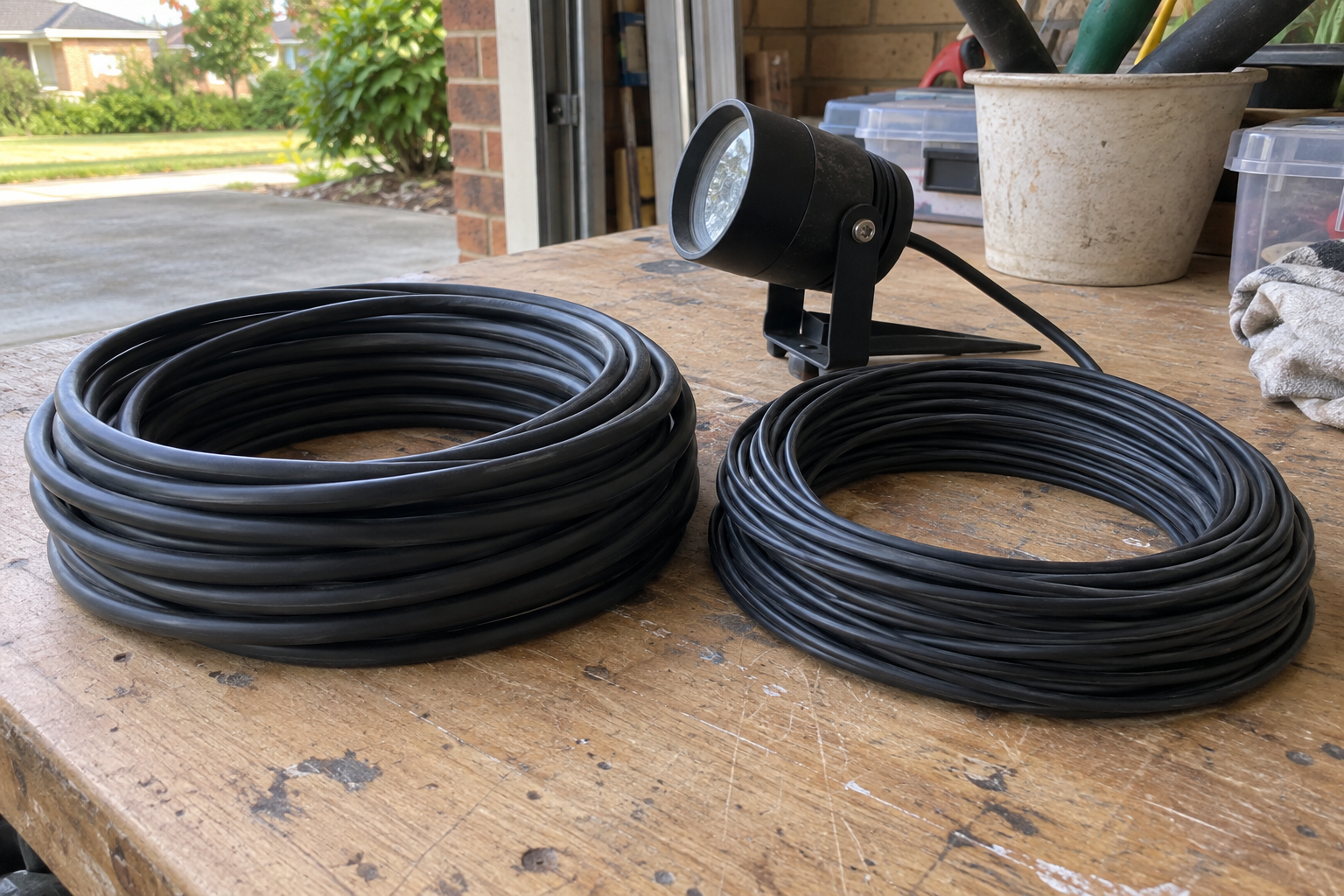
Start with layout. Can the supply be positioned closer to the lighting area using a suitable existing power point? Can an approved distribution arrangement split one long run into shorter branches? Avoid routing extra cable around the garden simply because it is easier to hide.
Next, check conductor size and the load on each branch. A larger suitable cable can reduce resistance, but it must fit the approved connectors and meet the installation requirements. Do not trim strands to force a cable into a terminal.
For a new system, compare a compatible 24V option. For LED strip, follow the manufacturer’s maximum continuous length and feed instructions. A strip’s internal copper tracks can create its own voltage drop even when the supply cable is adequate.
Do not turn up an adjustable supply beyond the lights’ permitted voltage to compensate. Fittings nearest the supply could then receive too much voltage.
How long can a lighting cable run be?
There is no single distance that works for every 12V or 24V system. Ten small lights, one high-output fitting and a long LED strip can place very different demands on the same cable.
Use a manufacturer run-length table or a calculator that reflects your layout. Where a supplier gives a percentage limit, treat it as guidance for that equipment rather than a universal rule for all lighting. The farthest fitting must still receive a suitable voltage under the intended operating conditions.
What to do if your lights are already dim
Check the obvious items first with the power disconnected: damaged cables, loose plug-in joints, moisture, incompatible replacements and added loads. Stop using damaged equipment. Have testing or repairs outside the kit’s permitted user checks handled by a qualified person.
Keep a drawing showing each fitting, its wattage and the distances between connections. It makes troubleshooting and future extensions much easier. Contact Future Lighting with those details if you need help planning a better run.
Technical references
The numerical examples above are illustrative calculations, not manufacturer-approved installation designs.
Images are original AI-generated illustrations of lighting applications.
[…] correctly sized supply can still feed a poorly designed run. Long or thin cables lose voltage, and the last fittings may receive less than they need. Increasing the supply’s wattage […]